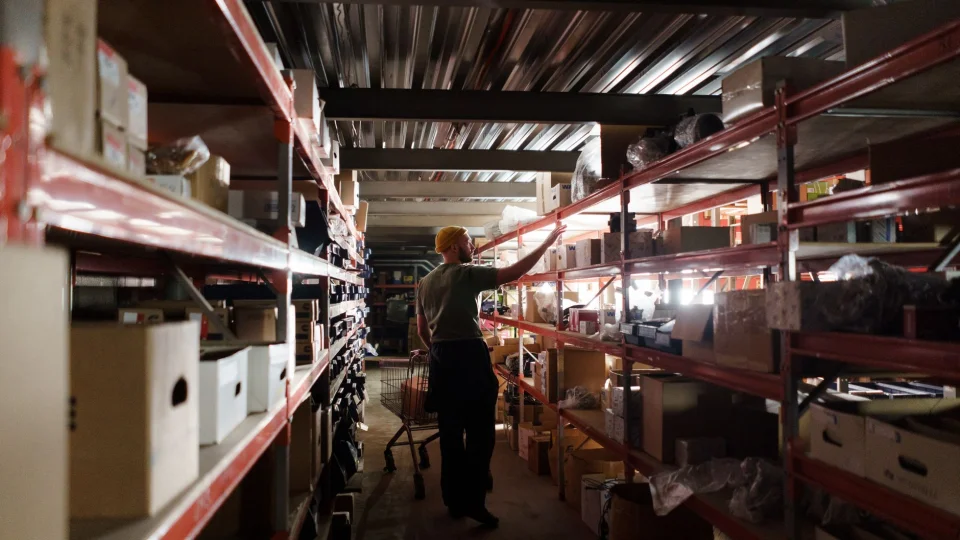
Your customer's maintenance team is standing next to a halted conveyor line at 7:45 in the morning. They know the part number. They have the quantity. They even know their contracted unit price because they negotiated it six months ago. What they don't have is a way to place the order without calling your inside sales desk, waiting on hold, and hoping the rep finds the right price tier in a spreadsheet before the shift supervisor starts asking questions.

This is a routine Tuesday for most industrial suppliers. And it's exactly the kind of friction that a B2B portal is built to eliminate.

## Why large SKU catalogues break down without a proper portal

Industrial suppliers routinely manage catalogues of 10,000 to 100,000+ SKUs — fasteners, seals, hydraulic fittings, cutting tools, safety equipment. Buyers across different sites and departments need different subsets of that catalogue, often with customer-specific part numbers mapped to your internal codes.

Without a searchable, filterable portal tied to the customer's actual account, buyers either call in every order or work from saved email threads and outdated PDFs. Both approaches introduce errors. Wrong part numbers. Superseded SKUs. Quantity mismatches that don't surface until a delivery arrives short. Research from the B2B commerce space consistently shows that companies handling high-volume repeat orders through manual channels see order error rates above 3% — errors that generate credit notes, reshipping costs, and support tickets that should never have existed.

A well-built portal lets buyers search by your SKU, their internal part number, or a keyword, see live stock status, and place orders against their active price agreements — without ever reaching your sales desk.

## Contract pricing is where self-service falls apart most often

Most B2B buyers don't pay list price. They're on negotiated agreements: volume tiers, customer-specific discounts, fixed contract prices valid for a quarter or a year. Showing a buyer the wrong price — either too high or too low — creates trust problems and, worse, downstream invoice disputes.

Generic e-commerce platforms bolt on pricing rules as an afterthought. The result is brittle: one customer's pricing breaks when a SKU is updated, or a new price list doesn't propagate cleanly. Buyers who've been burned once go back to calling their rep to confirm the price before placing any order, which defeats the purpose entirely.

A portal built for industrial distribution needs per-customer pricing baked into the data model from the start — not layered on top of a retail catalogue engine.

**FAQ: B2B portals and contract pricing**

*Can a B2B portal show different prices to different customers for the same SKU?*
Yes — a properly architected B2B portal stores pricing at the customer account level, so each buyer sees only their contracted rates when they log in. This requires the pricing model to be part of the platform's core data structure, not a plugin.

*What happens when a contract price expires or changes mid-year?*
A well-designed portal ties prices to dated agreements. When a contract expires, the portal either reverts to a default tier or flags the order for review — preventing buyers from accidentally ordering at an invalid price.

## Urgent reorders are a service call waiting to happen

Repeat ordering is where the ROI on a B2B portal is clearest. Industrial buyers reorder the same items on predictable cycles — monthly PM kits, quarterly consumables, annual safety stock replenishment. If they can reorder from their order history in three clicks, they will. If they can't, they call or email, and your team spends 20 minutes recreating an order that already exists in your system.

One industrial distributor reduced inbound reorder-related support contacts by 34% within four months of launching a customer portal with order history and one-click reorder functionality. That's not a marginal gain — it's a structural shift in how the support team spends its time.

## How Vendordesk helps industrial suppliers give buyers genuine self-service

Vendordesk is built as a combined B2B portal and Order Management System — the buyer-facing experience and the back-office operations run on the same platform, sharing the same data.

For industrial suppliers specifically, that means:

- **Per-customer catalogue and pricing configuration** without custom code — each account sees its contracted SKUs and rates, managed through the platform's rule engine
- **Order history and reorder workflows** built into the portal, so buyers can repeat a previous order or modify quantities without contacting support
- **Intake from real-world channels** — if a buyer still sends a PDF or an Excel sheet, Vendordesk stages it for human review before it touches live data, rather than rejecting it or passing errors downstream
- **Human-in-the-loop approval flows** — urgent or high-value orders can be routed for internal sign-off before confirmation, keeping your operations team in control
- **A hybrid AI model** that keeps sensitive pricing and customer data local, using public AI only for anonymised tasks — relevant for suppliers with contractually sensitive pricing agreements

The result is a portal that handles the organised majority of orders automatically and the messy minority carefully, without forcing buyers or your team to change every habit at once.

Try Vendordesk free and see how it handles your catalogue and pricing setup before you commit.
Photo by cottonbro studio on Pexels