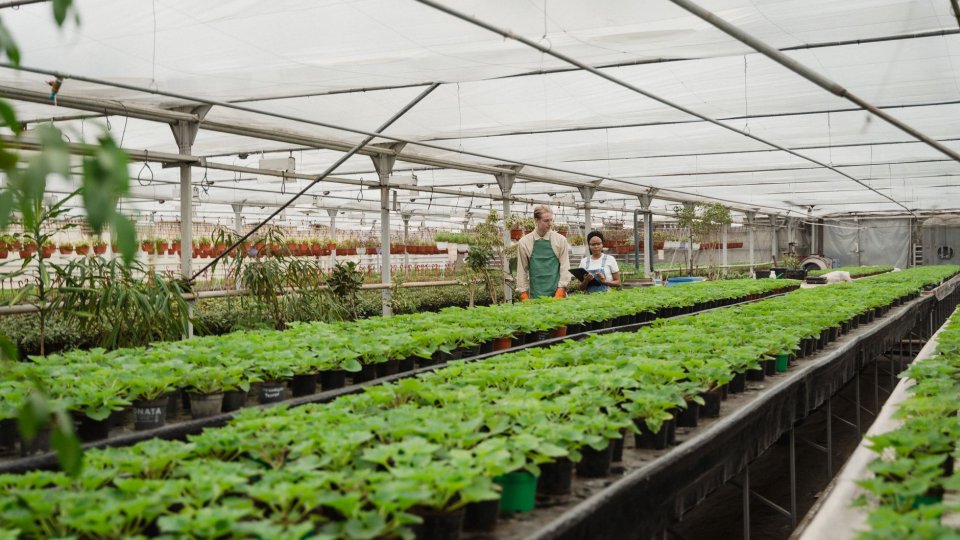
It's week 34. A landscaping contractor emails to ask whether you have 200 Liquidambars available for delivery in week 38. You forward it to the sales team. Someone checks a spreadsheet that was last updated Tuesday. By Thursday, you have an answer, but the contractor already ordered elsewhere.

This is not a one-off failure. For plant and flower wholesalers, it is the season.

## Why seasonal availability makes standard order management unworkable

Most B2B order management tooling was built around stable catalogues with predictable stock. Plant and flower wholesale is the opposite. Availability shifts weekly based on growing conditions, propagation cycles, and competing buyer demand. A batch of 500 Acer palmatum 'Bloodgood' available in week 36 might be fully reserved by week 33, or a late frost means it doesn't clear quality check at all.

When your buyers have to email or call to get that information, they're working from a picture that's already out of date. And when your team has to field those calls manually, they're spending time on status queries instead of managing actual orders. Research from Aberdeen Group suggests distribution companies relying on manual inquiry handling spend up to 30% of sales team capacity on inbound availability checks alone, time that produces no revenue.

## The email thread problem compounds in peak weeks

April through June. September through October. These are the crunch periods where a wholesaler might be fielding hundreds of simultaneous enquiries from nurseries, landscapers, garden centres, and municipal buyers, all with different lead times, volume requirements, and approval chains.

In this environment, email is actively dangerous. An order confirmation buried in a forwarded thread gets missed. A buyer sends a PDF with a hand-annotated quantity change that nobody catches. A quantity gets entered as 20 instead of 200. By the time the error surfaces, usually at dispatch, it's too late to repack and the buyer is furious.

These aren't edge cases. They're predictable failure modes of a channel that was never designed for high-frequency, time-sensitive B2B commerce.

**FAQ: B2B ordering for plant and flower wholesalers**

*Can plant wholesalers offer real-time stock availability to buyers without a custom-built portal?*
Yes. Modern B2B portal platforms can surface live availability directly from your inventory, updated as orders are placed and stock is reserved, without requiring custom development.

*How should wholesalers handle orders that arrive as emails, PDFs, or spreadsheets?*
The most practical approach is a system that ingests those formats, stages the parsed data for human review before committing it to live orders, and flags discrepancies automatically. This preserves the real-world intake channels buyers use while reducing manual re-entry errors.

## Per-customer rules matter more than a generic catalogue

Not all your buyers are equal. A national garden centre chain may have agreed pricing tiers, minimum order quantities, and a dedicated account manager. A small landscaping firm might be on standard pricing with a 48-hour lead time requirement. A municipal buyer might need a formal quote before any order can proceed.

A generic storefront handles none of this well. And an ERP bolt-on typically requires custom configuration work every time a new account-specific rule is needed. The operational reality for most wholesalers is that these per-customer rules live in someone's head, or in a notes field nobody reads.

## How Vendordesk helps plant and flower wholesalers manage seasonal order pressure

Vendordesk is built for exactly the kind of operational complexity that makes seasonal wholesale hard to scale.

- **Live availability in the buyer portal**: buyers check stock and place orders against current availability without calling, reservation happens at the point of order, not after a manual check.
- **Messy intake, handled**: orders arriving as PDFs, Excel attachments, or emails are ingested, parsed, and staged for human review before touching live data, reducing re-entry errors without forcing buyers to change how they order.
- **Per-customer configuration without code**: pricing tiers, lead time rules, approval flows, and minimum quantities are set per account through the platform's rule engine, no developer required.
- **Approval workflows that don't get stuck**: configurable approval routing means an order doesn't stall because one person is at a trade show; it routes to the next qualified approver automatically.
- **Order lifecycle visibility for both sides**: buyers track their own orders through the portal; your team manages the full lifecycle, intake, approval, fulfillment, invoicing, from one system.

If your team spends more time answering availability questions than managing orders, that's a structural problem, not a staffing one.

Try Vendordesk free and see how a combined portal and order management system handles the season without the chaos.
Photo by Tima Miroshnichenko on Pexels