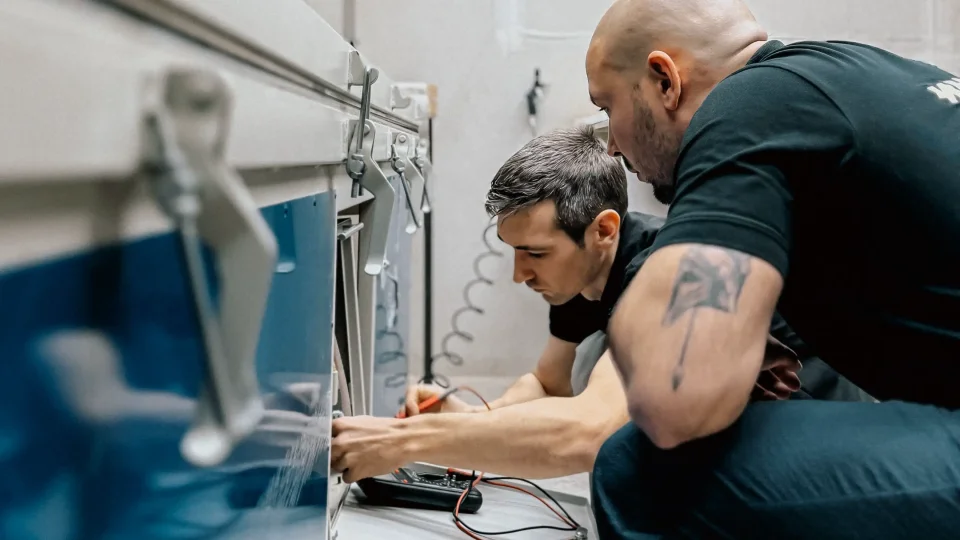
It's 7:40 on a Tuesday morning. A production line at a food packaging plant has stopped because a conveyor drive shaft seal has failed. The maintenance engineer knows the part number, or thinks he does. He opens your website, searches, gets no results, tries a variation, still nothing. He calls your sales line. It's ringing out. He opens a competitor's portal, finds the part in 45 seconds, checks stock, and places the order before your phone is even answered.

You didn't lose that customer on price. You lost them on friction.

## The spare parts catalog problem goes deeper than most distributors admit

Most spare parts catalogs weren't designed — they accumulated. SKUs were added as products arrived, part numbers were entered however the supplier labeled them, and superseded parts were never properly cross-referenced. The result is a catalog that works fine if you already know exactly what you're looking for and how your specific distributor has named it.

Buyers rarely do. They might have the OEM number, a part description from a worn machine plate, or a photograph. They expect your catalog to bridge that gap. When it doesn't, your support team absorbs the load — fielding lookup calls, cross-referencing manually, and emailing back availability figures that were accurate an hour ago.

One mid-size industrial parts distributor found that 34% of inbound support calls were purely catalog navigation queries — customers trying to confirm a part number or check whether a superseded SKU had a replacement listed. None of those calls required human expertise. They required accessible, structured data.

## Compatibility and supersession data is where most portals fall short

A buyer searching for a hydraulic pump seal doesn't just need to find the SKU. They need to know: Does this fit a Series 4 unit or a Series 5? Is this part still current, or has it been superseded by a newer revision? Is there a compatible alternative in stock if the original isn't available?

Without that context surfaced at the point of search, the buyer either calls you, guesses and orders the wrong part, or leaves.

Ordering the wrong part has compounding costs. The buyer's line stays down longer. Your warehouse processes a return. The correct part ships late. The buyer remembers the experience, not the eventual resolution.

**FAQ: Spare parts self-service portals**

**Q: What information should a B2B spare parts portal show at the product level?**
A: At minimum: current availability, lead time, supersession status, compatible models or equipment series, and any unit-of-measure constraints. Buyers making urgent purchasing decisions need all of this without a phone call.

**Q: How do spare parts distributors handle superseded part numbers in a portal?**
A: The most effective approach is automatic cross-referencing, when a buyer searches an obsolete SKU, the portal surfaces the current replacement and flags the change clearly, rather than returning zero results.

## The distributors gaining share are solving this systematically

The competitive gap isn't between distributors who have a portal and those who don't. It's between distributors whose portal surfaces structured, trustworthy product data and those whose portal is effectively a searchable spreadsheet.

Structured data means: supersession chains are explicit, compatibility is filterable, availability reflects real inventory, and the buyer can reach a confirmed order without leaving the screen. That experience doesn't just reduce support load, it builds the kind of reliability that earns repeat orders without a sales touch.

## How Vendordesk helps spare parts distributors compete on catalog quality

Vendordesk is built for exactly this operational gap. Here's where it addresses the specific problems above:

- **Structured product catalog with supersession support** — Part relationships, replacements, and compatibility data are first-class fields, not notes in a description box.
- **Real-time availability in the buyer portal** — Buyers see live stock status and lead times at the product level, eliminating the availability call.
- **Per-customer catalog configuration** — Show only the parts relevant to each customer's equipment fleet, reducing noise and lookup errors without custom code.
- **Messy order intake handled cleanly** — Buyers who still send PDF part lists or email orders with handwritten annotations aren't a problem. Vendordesk ingests those inputs, stages them for review, and keeps them out of live data until they're confirmed.
- **Human-in-the-loop on ambiguous orders** — When a part number doesn't resolve cleanly, the system flags it for review rather than silently passing through a wrong SKU.

If your support team is spending its day answering catalog questions that a well-structured portal should handle automatically, the fix isn't hiring — it's architecture.

Try Vendordesk [free for 7 days](https://www.vendordesk.eu/free-7-day-trial).
SPARE PARTS
JUL 06, 2026 · 4 MIN READ
Why Spare Parts Distributors Lose Customers to Better Online Catalogs
When a machine goes down, buyers need the right part in minutes, not a phone call and a wait. Here's why catalog accessibility is now a competitive differentiator.
W
Vendordesk
// Keep reading